Guide
Readiness, explained
Readiness is one number for how hard you can go today, built from last night’s sleep, your HRV and your resting heart rate. Garmin, Oura, WHOOP and Shape all have a version. This guide explains how they work, using Shape’s as the example, and why they often disagree.
 Samuel KraftUpdated
The short version
- Readiness is one score from 0 to 100 for how ready your body is to train today, measured against your own normal. An ordinary morning lands around 68.
- HRV is how much the time between heartbeats varies at rest. Higher than your normal is good.
- Resting heart rate is your pulse at rest. Lower than your normal is good.
- Sleep is how long you slept last night. More than you usually get is good.
Your normal, not everyone’s
A resting heart rate of 53 is perfectly healthy. For most people it would mean nothing. For the made-up athlete this guide follows, whose resting heart rate usually sits around 46, it means something is up.
That’s why readiness never compares you with other people. Every reading is measured against your own last 60 days: what is normal for you, and how much it usually wobbles from day to day.
That “times the usual wobble” is what the Today page shows as σ. Half a σ is an ordinary day. Two is a long way from your usual. It needs 14 days of readings before it can say anything at all.
The three readings
HRV
Heart rate variability is how much the time between your heartbeats varies at rest, usually measured overnight. A relaxed, recovered body varies more. Stress, illness, alcohol and hard training tend to push it down, often a day or two before you feel anything. Higher than your normal is good.
Resting heart rate
Your pulse at rest, usually measured overnight. It moves more slowly than HRV and is harder to fool. Lower than your normal is good. A few beats above normal for several mornings in a row is one of the clearest signs of a cold, or of training that’s not being absorbed.
Sleep
How long you slept, against how long you usually sleep. It’s the reading you can do the most about, and a short night shows up in the score the next morning.
How they add up
Each reading gets a share of the score. HRV gets the biggest because it moves first. Your load ratio from the fitness, fatigue and form guide gets a small one, since Shape shows it separately.
- HRV moves first, often a day or two early35%
- Resting heart rate a slower, steadier signal30%
- Sleep how long you slept25%
- Load ratio this week against your usual10%
If your watch doesn’t measure one of them, it simply drops out and the others count for more. You’re not marked down for owning a watch without HRV. The one rule is that a score needs last night’s sleep or HRV: a resting heart rate on its own, taken from a few minutes of wearing the watch in the morning, isn’t enough to go on.
What the score means
A morning exactly at your normal scores 68, in the middle of Moderate. That’s on purpose: an ordinary day should look ordinary, not like a warning. A morning one usual wobble better than normal scores about 80. One worse scores about 50. It takes a truly rough night to fall below 25, and a run of excellent readings at once to reach Prime.
- Under 25Poor
- You have not recovered. Rest is the session.
- 25 to 49Low
- Recovery is lagging. Steady or easy work today.
- 50 to 74Moderate
- Recovered enough to train. Keep it to your usual load.
- 75 to 95High
- Well recovered. Most sessions are on the table.
- Over 95Prime
- Recovered and ready. A good day for the hard session.
Shape always lists what moved the score, worst first. A number on its own is hard to trust. “43: resting heart rate up, HRV down” is something you can check against how you feel.
It drops as you train
Readiness isn’t only a morning number. It also counts what you’ve already trained today, so it falls as you use the day up. A fresh morning at 86 drops to 75 after a normal day’s training and to 48 after a very big one. Move the slider to see it.
Well recovered. Most sessions are on the table.
A morning with nothing trained yet gets no bonus, or every rest day would look like peak form. And the drop stops at a limit, because what an enormous day really cost you shows up tomorrow morning, in your heart rate and your sleep.
Readiness and form
Form comes from your training log. It says what the work you did should have done to you. Readiness comes from your body. It says what actually happened.
Most days they agree. When they don’t, the body is usually right about today. In the hard week in this guide, readiness fell to 45 as HRV sagged. During the cold it fell to 43 even though nothing in the training log had changed. Use readiness to decide today’s session, and form to plan the weeks around it.
Why your watch says something else
Garmin, Oura, WHOOP and Shape all put a number on your morning, and on the same morning they rarely agree. That’s expected: they read different things and weigh them differently.
| Score | What it reads |
|---|---|
Garmin Training Readiness | Last night's sleep score, recovery time, HRV status and acute load, plus sleep over the last three nights and stress over the last three days. Updates through the day. Garmin manual |
Oura Readiness | Last night's sleep, sleep balance and regularity over two weeks, the previous day's activity, activity balance, resting heart rate, HRV balance, body temperature and a recovery index. Oura |
WHOOP Recovery | HRV and resting heart rate, which it calls the two biggest factors, plus respiratory rate, sleep against what you needed, sleep stages, skin temperature and blood oxygen. Calculated during sleep. WHOOP support |
Shape Readiness | Last night's sleep, HRV and resting heart rate against your own last 60 days, your load ratio, and what you’ve trained today. This guide |
So a night with a raised skin temperature can pull Oura and WHOOP down while Shape, which doesn’t read temperature, stays where it was. Garmin also counts your stress over the last three days, which Shape doesn’t. And even when two scores read the same inputs, the arithmetic differs.
Pick one and learn how it behaves for you, rather than comparing them. Whichever you use, look at what moved it.
When there’s no score
- Your first two weeks
- Readiness compares today with your normal, and it takes 14 days of readings to know what normal is. Until then there’s nothing fair to compare with, so there’s no score.
- No reading of the night
- A score needs last night's sleep or HRV. If the watch was on the charger, or hasn’t synced yet, wear it to bed and sync in the morning.
- A device that measures none of it
- Some watches and apps only record workouts. Readiness needs sleep, HRV or resting heart rate from somewhere, such as a Garmin watch or Apple Health.
Things that throw it off
- Sleeping long while ill. Sleep counts hours, not how restful they were. On the worst day of the cold this athlete slept 8.8 hours, which scored as good sleep. Resting heart rate and HRV are what caught the cold.
- Switching watches. Different devices measure HRV in different ways, and the numbers are not comparable. Shape only compares a night with earlier nights measured the same way, so a new watch may need a couple of weeks before HRV counts again.
- A late night, a few drinks, a stressful week. These usually do show up, as a lower HRV and a higher resting heart rate. That’s readiness working, not a fault. The late night in this guide scored 25.
Questions
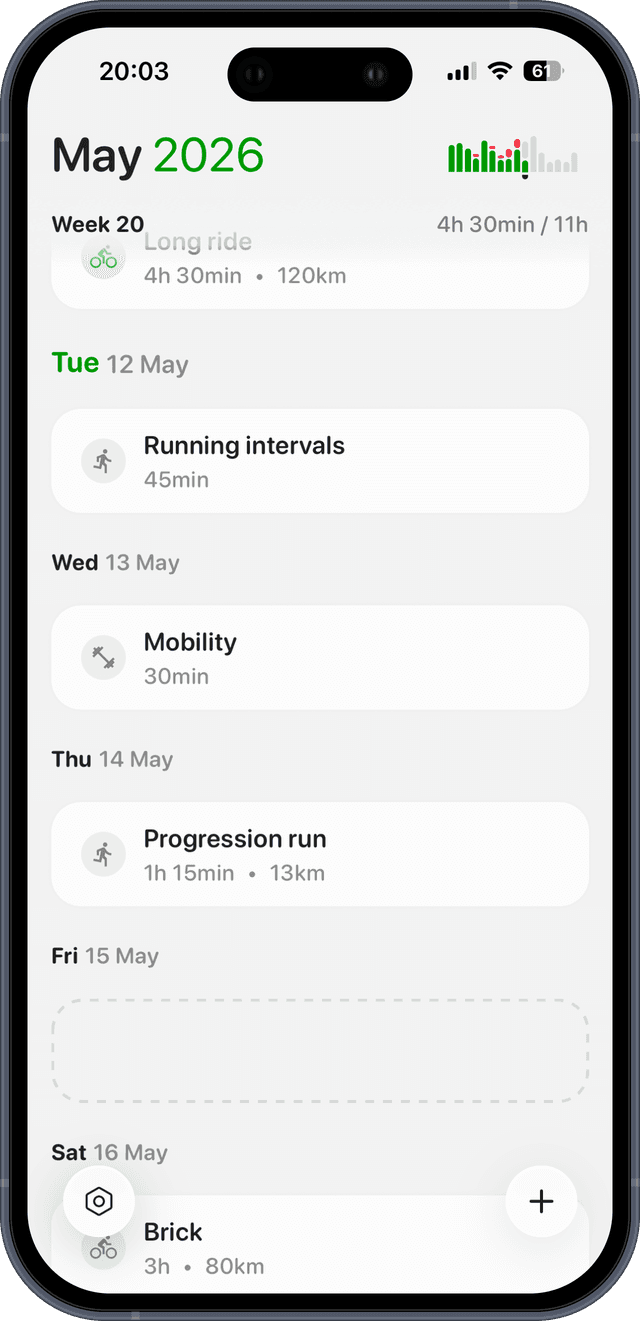
See your own readiness every morning.
Connect Garmin or Apple Health and Shape learns your normal, then scores each morning against it and tells you what moved it. Free for 14 days.